Subcellular-Resolution Molecular Pathology by Laser Ablation−Rapid Evaporative Ionization Mass Spectrometry
Dániel Simon, Gabriel Stefan Horkovics-Kováts, Yuchen Xiang, Ronan A.Battle, Yu Wang, Julia Abda, Dimitris Papanastasiou, Stefania Maneta Stavrakaki, Hui-YuHo,Haixing Wang, Richard Schäffer, Tamás Karancsi, Anna Mroz, István Pap, Laurine Lagache, Júlia Balog, Isabelle Fournier,
Robert T.Murray, Josephine Bunch, and Zoltan Takáts*
Analytical chemistry
https://doi.org/10.1021/acs.analchem.5c02013
Abstract
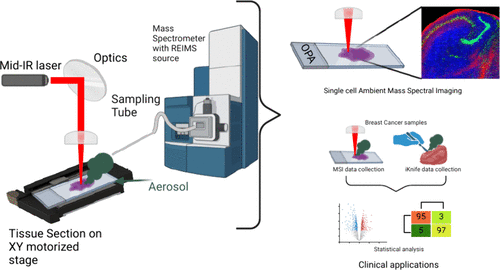
This work demonstrates the combination of ambient laser ablation (LA) with in-source surface-induced declustering, originally developed for rapid evaporative ionization mass spectrometry (REIMS). This combination, termed laser ablation REIMS (LA-REIMS), provides sensitivity, spatial resolution, and chemical coverage comparable to matrix-assisted laser desoprtion ionization (MALDI) but without the requirement for matrix deposition. The atmospheric pressure interface setup was subjected to detailed characterization with regard to geometric and thermal parameters augmented by in-silico flow modeling. The resulting platform was tested using aerosol formed by the infrared laser ablation of tissues. Three different laser systems were successfully employed for ambient mass spectrometric imaging: a carbon dioxide laser (λ = 10.6 μm, τL = ∼100 μs), an optical parametric oscillator (OPO; λ = 2.94 μm, τL = 8 ns), and an optical parametric amplifier (OPA; λ = 3.0 μm, τL = ∼30 ps). Single-cell imaging was achieved using the high-resolving capabilities of the OPA systems, and metabolites and lipids ranging from amino acids through carbohydrates and nuclear bases to complex glycolipids were successfully detected. The technique was also tested as a platform for MS-guided surgery, raising the possibility of using a single technique for generating histological and in vivo data.