Placental Extracellular Vesicles Exhibit Reduced Neurogenic Potential Linked to Changes in Their miRNA Landscape Upon HCMV Infection
Charlène Martin, Hélène Martin, Mathilde Bergamelli, Lhorane Lobjois, Lucie Franco, Emma Bordes, Alexandra Benchoua, Stéphanie Balor, Diala Kantar, Etienne Coyaud, Frédéric Martins, Alexandre Favereaux, Cécile E. Malnou
Journal of Extracellular Biology
https://doi.org/10.1002/jex2.70108
Abstract
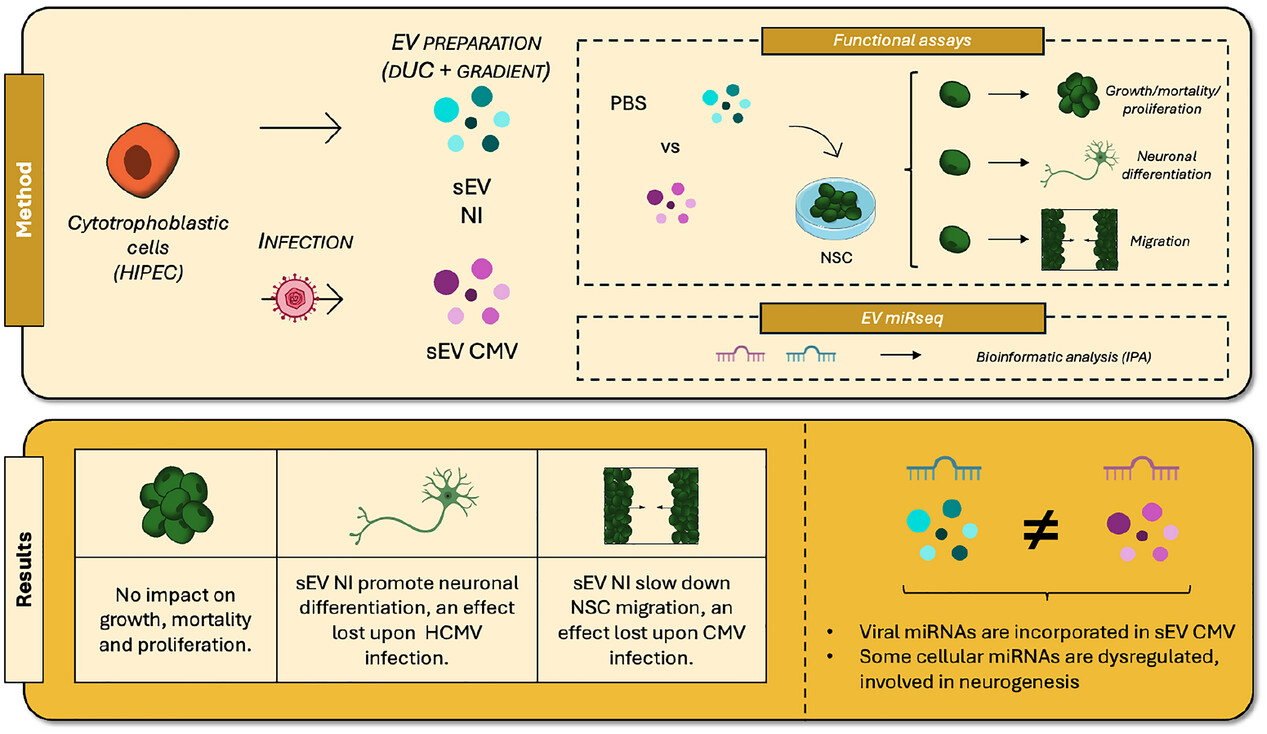
Extracellular vesicles (EVs) are key mediators of maternal–foetal communication, regulating placental function and foetal development through the transfer of bioactive molecules. Although placental EVs play a crucial role in placental function during pregnancy, their contribution to foetal development, notably foetal brain, remains poorly understood. Human cytomegalovirus (HCMV) is the most common virus transmitted in utero and a leading cause of infectious brain malformations. Although certain central nervous system lesions caused by HCMV are explained, the neuropathogenesis of congenital infection remains poorly understood. In this study, we demonstrate that EVs from healthy placentas promote neurogenesis. However, EVs from HCMV-infected placentas lose this neurogenic potential, impairing differentiation and migration of neural stem cells, perturbations that may contribute to the neurodevelopmental defects observed in congenital HCMV infections. miRNA profiling revealed profound infection-induced changes, including the incorporation of viral miRNAs and dysregulation of host miRNAs involved in neurogenesis. These findings highlight the critical role of placental EVs in foetal brain development and their contribution to HCMV neuropathogenesis.