Epithelial-Mesenchymal Transition Shapes the Lipotoxic Response of Colon Cancer Cells to Palmitic Acid
Francesco Vari, Ilaria Serra, Elisa Bisconti, Eleonora Stanca, Antonella Raffo-Romero, Sarah Mehenni, Yanis Zirem, Daniele Vergara, Isabelle Fournier, Anna Maria Giudetti, Michel Salzet
Mol Cell Proteomics
https://doi.org/10.1016/j.mcpro.2026.101554
Abstract
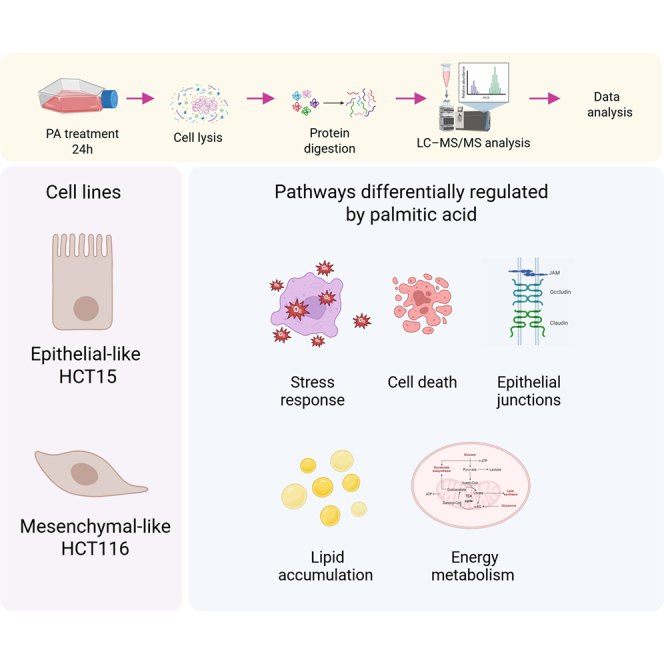
Saturated fatty acids such as palmitic acid (PA) can induce lipotoxic stress, whereas monounsaturated fatty acids like oleic acid (OA) often promote adaptive responses through lipid droplets (LDs) formation. Here, we reveal that epithelial-mesenchymal transition (EMT) profoundly influences the lipotoxic response of colorectal cancer cells. Using the epithelial-like HCT15 and mesenchymal-like HCT116 cell lines, we combined proteomic, metabolic, and imaging analyses to elucidate how EMT status determines lipid storage capacity and resistance to PA-induced toxicity. A basal proteomic profiling highlighted a striking divergence in metabolic changes: HCT15 cells displayed enhanced glycolysis and reduced expression of LDs biogenesis proteins, while HCT116 cells exhibited oxidative metabolism and a “lipid-rich” proteomic signature enriched in PLIN2, GPAT3, and DGAT1. Functionally, PA triggered massive cytotoxicity and failed to induce LDs in HCT15 cells, correlating with DGAT1/2 downregulation and suppressed triacylglycerol synthesis. In contrast, HCT116 cells showed modest LDs accumulation, preserved mitochondrial function, and strong resistance to lipotoxic stress. OA treatment restored LDs formation and cell viability in both models, underscoring the protective role of unsaturated fatty acids. Notably, forced EMT induction in HCT15 cells by PMA markedly enhanced LDs accumulation and reduced PA-induced death, confirming that EMT confers metabolic plasticity and lipid-buffering capacity. These findings demonstrate that EMT status modulates differential lipid handling and stress adaptation in colon cancer cells, linking mesenchymal transition to enhanced LDs biogenesis and survival under lipotoxic conditions. Data are available via ProteomeXchange with identifier PXD071641.