The evolution of MALDI mass spectrometry imaging
Laurine Lagache, Michel Salzet, Isabelle Fournier
Trends in Analytical Chemistry
https://doi.org/10.1016/j.trac.2026.119195
Abstract
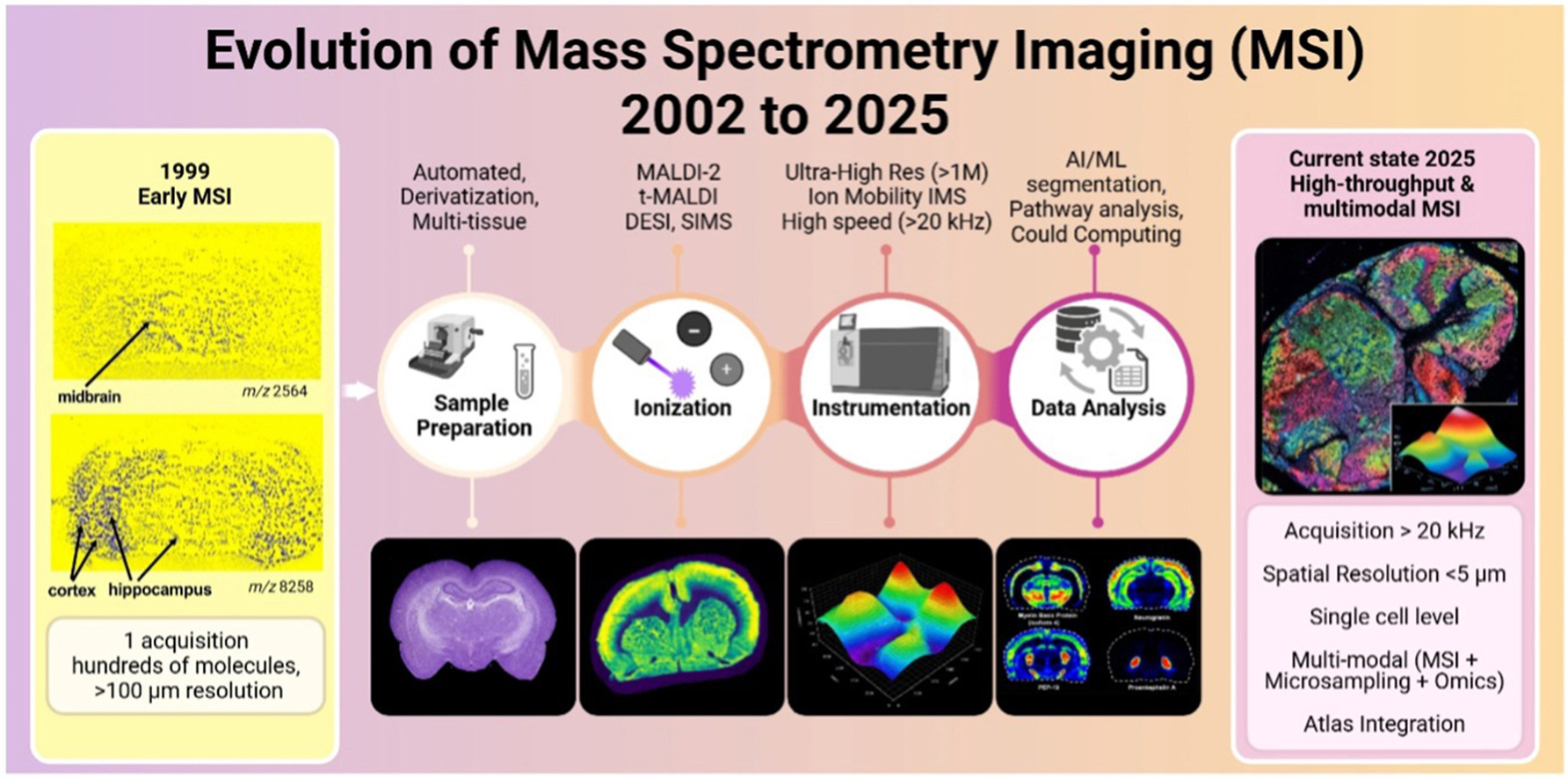
Matrix-assisted laser desorption/ionization imaging mass spectrometry (MALDI-MSI) has evolved from an experimental concept into a versatile analytical platform that links molecular information to spatial context. Since its development in the 1980s as a soft ionization method, the field has progressed through key advances in sample preparation, matrix chemistry, instrumentation, and computational analysis. The first molecular images of tissue sections in the 1990s enabled the label-free visualization of proteins, lipids, metabolites, and drugs directly in situ, establishing MALDI-MSI as a widely used technique in fundamental proteomics and clinical pathology. Over the past two decades, improvements in sensitivity, spatial resolution, and reproducibility have broadened its applications in pharmacology and microbiology. More recently, specialized approaches such as high-resolution mass analyzers, ion mobility separation, MALDI-2 post-ionization, two-laser post-desolvation, and multimodal image fusion have demonstrated proof-of-concept capabilities toward single-cell and subcellular imaging. Emerging technologies, including in vivo molecular imaging with SpiderMass, integration with machine learning, and combination with spatial transcriptomics, remain largely exploratory and often rely on customized setups. This review traces the historical development of MALDI-MSI, highlights major technical and biomedical milestones, and distinguishes between established applications and experimental directions that may shape its future in research and clinical translation.