Patient-derived complex organoids are a critical tool to understand and explore pediatric malignant brain tumors
Marlène Deschuyter, Sophie Martin, Chinar Salmanli, Clémence Hubsch, Audrey Vincent, Samuel Meignan, Alessandro Furlan, Erika Cosset, Hélène Burckel, Georges Noel, Michel Salzet, Marie Duhamel, Antonella Raffo-Romero, Cedric Boura, Sophie Pinel, Andres Coca, Antony Joud, Mélodie Anne Karnoub, Pascal Chastagner , Sandra Raimbault, Hélène Sudour-Bonnange, Vincent Flacher, Chloé Bernhard, Natacha Entz-Werlé
Cancer Metastasis Rev
https://doi.org/10.1007/s10555-026-10316-3
Abstract
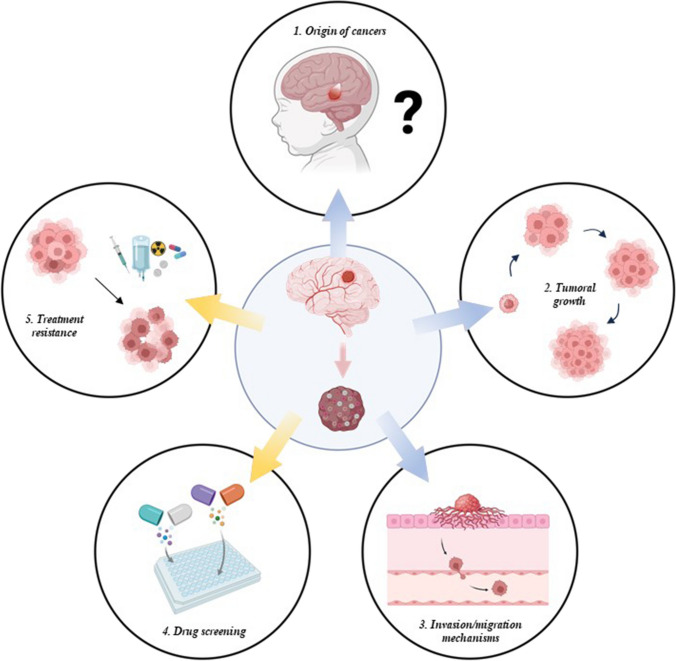
Pediatric malignant brain tumors (PMBTs) remain among the most common and challenging cancers in children and adolescents, with current therapies often failing to deliver satisfactory outcomes. A major obstacle is their intrinsic and extrinsic resistance mechanisms, underscoring the urgent need for innovative therapeutic strategies and accurate preclinical modeling. Recent advances in organoid-based technologies offer promising tools to mimic PMBTs more faithfully in vitro. These three-dimensional (3D) models can replicate key features of the tumor and its brain-like microenvironment, providing valuable platforms for studying resistant cancer cells and testing novel treatment approaches. This review discusses the relevance of cultured 3D systems, organoids and tumoroids, in pediatric neuro-oncology, emphasizing their role in precision medicine. These models have become essential for dissecting the complex biology and dynamic biological processes of all PMBTs, while bridging clinical challenges with experimental discoveries, ultimately enabling more effective and personalized treatments for young patients.