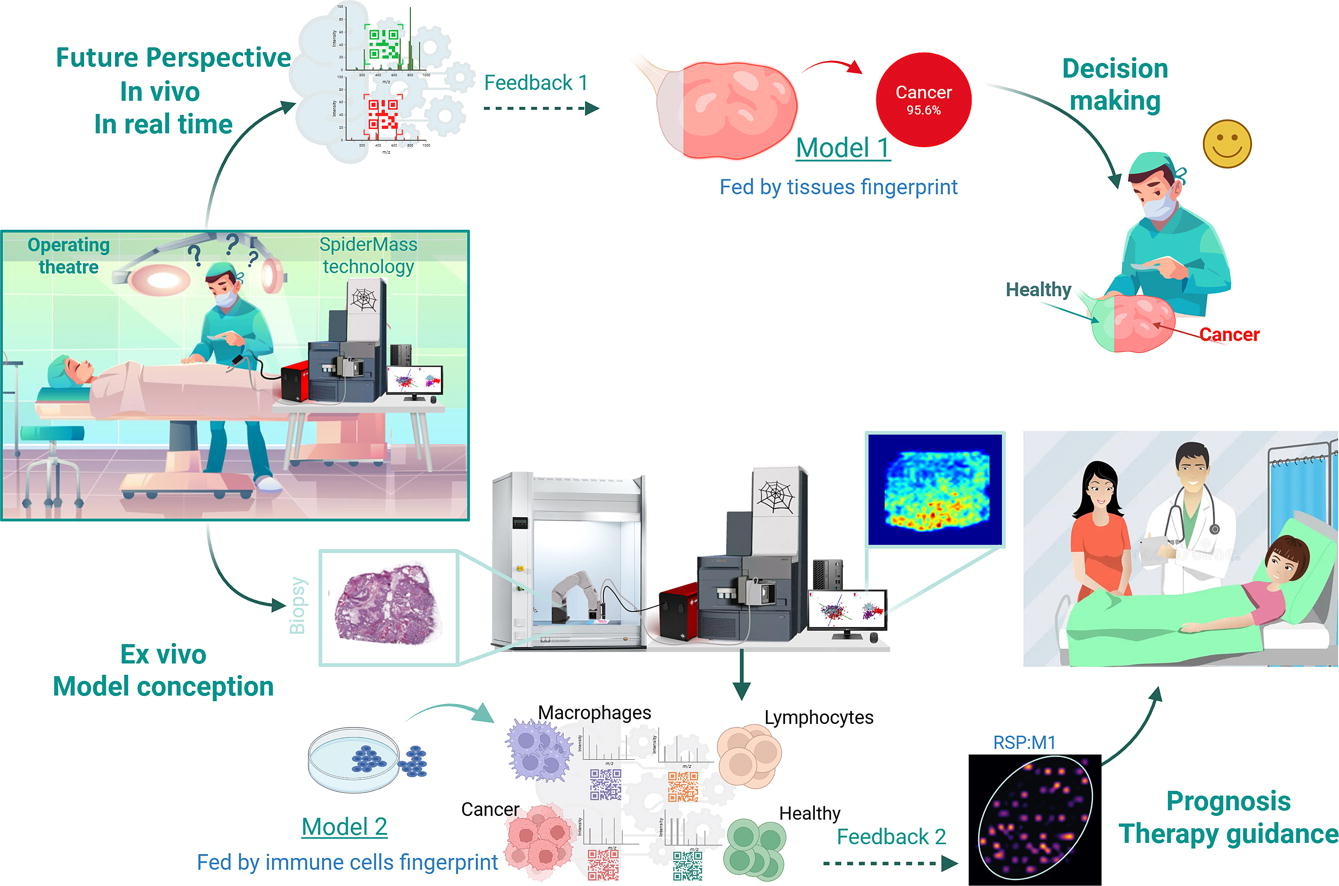
SpiderMass ambient mass spectrometry and multimodal machine learning enable ex vivo ovarian cancer typing and exploratoryimmunoscoring
Léa Ledoux,Yanis Zirem, Laurine Lagache, Lucas Roussel, Delphine Hudry, Bertrand Meresse, Marie Delbeke, Eric Leblanc, Yves-Marie Robin, Camille Pasquesoone, Delphine Bertin, Fabrice Narducci, Michel Salzet, Isabelle Fournier
Journal of Advanced Research
https://doi.org/10.1016/j.jare.2026.07.022
Abstract
Complete cytoreductive surgery remains one of the strongest determinants of outcome in ovarian cancer, yet surgeons still lack rapid tissue-assessment tools that can be repeated throughout an operation. Here we evaluated whether SpiderMass ambient mass spectrometry, combined with machine-learning models, could support ex vivo ovarian tissue typing and exploratory immune microenvironment mapping. A total of 128 ovarian specimens, from 119 patients, were analyzed to train subtype-classification models from fresh-frozen and formalin-fixed paraffin-embedded (FFPE) material, and 24 independent tissues were reserved for blinded region-level testing. Initial PCA-LDA models were improved by screening 24 classifiers; Ridge models reached up to 97% 5-fold cross-validation accuracy on the combined cohort. In blinded analyses, the mixed Ridge model produced the fewest errors, although misclassification remained concentrated in underrepresented endometrioid regions. A dual-input network combining SpiderMass spectra with digitized histology improved internal performance to 99% in 5-fold cross-validation and 100% on a small, blinded image-spectrum set, outperforming the molecular-only branch. Model explanation followed by MALDI-MSI cross-checking identified 26 subtype-associated lipids. We then trained a LightGBM cell-state model from immune and epithelial cell spectra and applied it to SpiderMass imaging data. Spatial predictions were broadly concordant with multiplex MALDI-IHC and highlighted subtype-specific differences in immune-cell distribution. In an exploratory analysis of eight high-grade serous carcinoma samples obtained before chemotherapy, longer survival was associated with higher lymphocyte scores, higher M1-like macrophage scores, and a higher M1/M2 ratio, whereas shorter survival was associated with higher cancer-cell scores. These data support SpiderMass as a promising ex vivo platform for ovarian cancer typing and hypothesis-generating immunoscoring, while underscoring the need for prospective intraoperative studies, orthogonal biomarker validation, and multicenter patient-level external validation before clinical implementation.